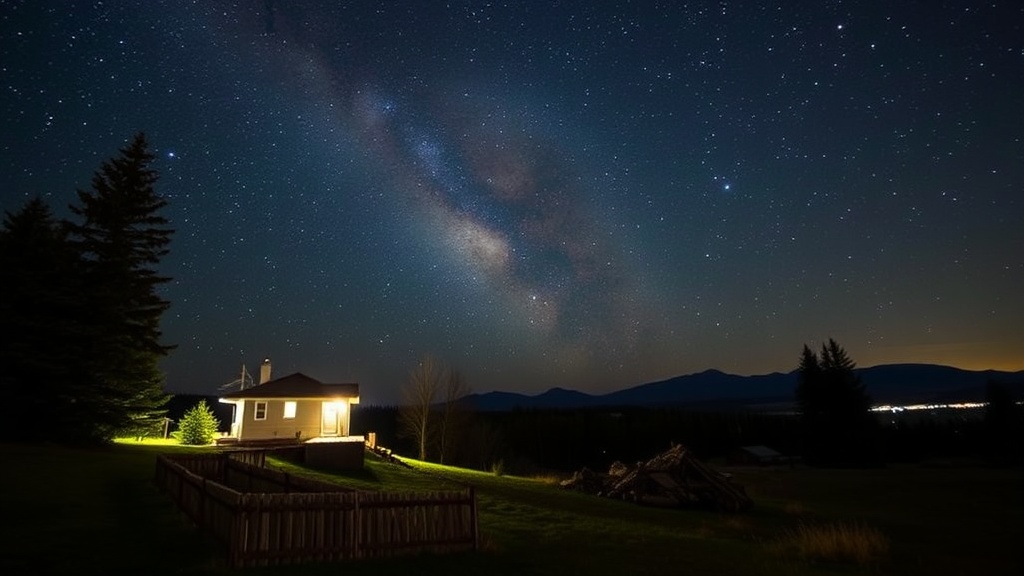
Best Spots to Watch the Stars Over Camrose

Mirror Lake Perimeter
The Rural Backroads South of Town
The Quiet Corners of Battle Lake Provincial Park
This post identifies the best locations around Camrose, Alberta, for stargazing and provides practical advice on when to go, what gear to bring, and how to find the darkest skies in our region. You'll find specific spots ranging from local parks to nearby rural areas to help you see the Milky Way clearly.
Where are the best places to stargaze near Camrose?
The best spots for stargazing near Camrose are the rural areas outside the city limits, specifically the open fields near Battle Hill and the outskirts of Lincoln.
If you stay within the city limits, the light pollution from streetlights and residential buildings makes it hard to see anything beyond the brightest stars. You need to get away from the glow. While we don't have a massive mountain range here, our flat prairie landscape actually provides a massive, unobstructed view of the horizon—which is perfect for seeing the Milky Way during peak seasons.
One of my favorite spots is the area around the Battle Hill region. It's far enough away from the main streetlights of Camrose to give you a much darker sky. Another great option is heading towards the Vernon Lake area. It's a bit more secluded and offers a sense of peace that you just can't get in a suburban backyard.
If you want something a bit more structured, the Battle Lake Provincial Park area (just a short drive away) is a fantastic destination. It offers a much darker sky than the town center. It's also a great place to combine a daytime hike with an evening of astronomy. If you've already explored the area, you might want to visit Mirror Lake at sunset to see how the light fades before the stars come out.
Top 3 Stargazing Locations Near Camrose
- The Outskirts of Lincoln: This is a prime spot for those who want minimal light pollution without driving too far. The fields here are wide open.
- Battle Hill Area: Great for elevation and clear sightlines. It's a bit more rugged, but the views are worth it.
- Rural County Roads (East of Camrose): Driving a few minutes east on the secondary highways will get you into much darker territory very quickly.
What gear do I need for stargazing in Alberta?
You need a comfortable way to sit or lie down, a reliable red-light flashlight, and layers of warm clothing to combat the Alberta chill.
Don't underestimate how fast the temperature drops once the sun goes down in central Alberta. Even in July, the air can get crisp. I always keep a Patagonia Nano Puff or a heavy wool blanket in my car specifically for these trips. If you're cold, you won't be looking up; you'll be looking at your watch.
A red-light flashlight is a must. Why red? Because white light ruins your night vision. Once your eyes adjust to the dark, a bright phone screen or a regular flashlight will blind you for twenty minutes. You can find inexpensive red-light headlamps at most outdoor stores, or just use a red piece of cellophane over your phone light.
If you're serious about it, a pair of binoculars is actually more useful than a telescope for beginners. A telescope can be finicky and hard to aim. Binoculars like the Nikon Prostaff allow you to scan the sky easily and see things like the moons of Jupiter or the Andromeda Galaxy without the frustration of complex setup.
| Gear Type | Recommended Use | Must-Have Example |
|---|---|---|
| Light Source | Preserving night vision | Red-light headlamp |
| Optics | Scanning the Milky Way | 10x50 Binoculars |
| Comfort | Staying warm in Alberta | Insulated ground pad |
| Navigation | Finding dark spots | Offline GPS maps |
When is the best time to watch stars in Camrose?
The best time to watch the stars is during a New Moon phase when the sky is at its darkest and the Milky Way is most visible.
The moon is a massive light source. If the moon is full, it's beautiful, but it washes out the fainter stars and the Milky Way. For the absolute best experience, check a lunar calendar and aim for the week around the New Moon. This is when the sky is truly black.
Seasonally, summer and autumn are the heavy hitters for Alberta stargazers. The Milky Way's core is most prominent during the warmer months. However, the winter skies are incredibly clear because the air is much drier and less turbulent. Just remember that winter stargazing requires much more preparation regarding warmth (and maybe a thermos of hot coffee from one of the local coffee shops to keep you going).
Check the Environment Canada website before you head out. You're looking for high-pressure systems and low humidity. If there's a high probability of cloud cover, don't bother driving out to a dark spot—you'll just be staring at a gray ceiling.
It's also worth checking the Light Pollution Map online. This tool is a lifesaver. It shows you exactly how much "glow" is coming from the Camrose area and helps you find the gaps in the light. It's a game-changer for finding those truly dark pockets in rural Alberta.
The way the light interacts with our atmosphere can be unpredictable. Sometimes, a slight haze from nearby agricultural activity can dull the view. If you see a "milky" haze near the horizon, it might be dust or moisture. On a clear night, the stars don't just twinkle; they almost seem to pulse.
If you're a beginner, don't feel like you need to be an expert. Just grab a chair, a warm blanket, and a star map app. There's something deeply humbling about looking up at the cosmos from a quiet field in Camrose County. It makes the daily grind feel a lot smaller.
One thing to keep in mind: always let someone know where you're going. If you're heading out to a remote area near Lincoln or a back road, it's just common sense. Cell service can be spotty once you get deep into the fields, and you don't want to be stranded if you're out past midnight.
For those who want to get even more technical, the Wikipedia page on Astronomy is a great place to start learning about the different celestial bodies you might see. Knowing the difference between a planet and a star can actually make the experience much more rewarding.
The next time you see a clear, moonless night on the weather report, don't just stay inside. Pack your gear, drive a few kilometers out of town, and look up. The view is much better than anything you'll see on a screen.